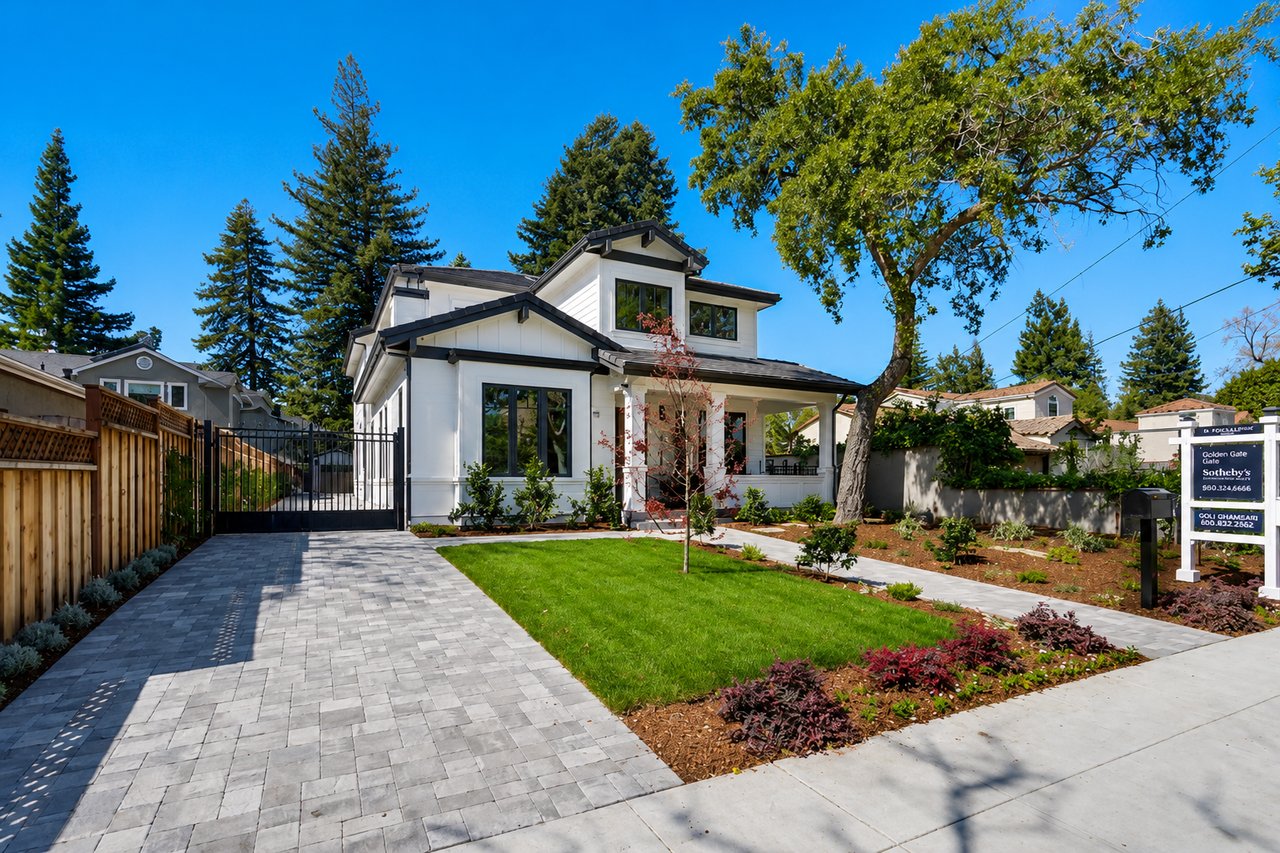
How Much Income Do You Need to Buy a Home in Palo Alto?
Real Estate 101 | Palo Alto June 15, 2026
Real Estate 101 | Palo Alto June 15, 2026
It's one of the first questions serious buyers ask and one of the hardest to get a straight answer on. Palo Alto is a city where the standard rules of affordability stretch well past what most financial guidelines are designed to handle. A household income that would comfortably support homeownership almost anywhere else in the country doesn't get you far here.
So what does the number actually look like? The honest answer depends on the price point you're targeting, how lenders will qualify your income, and how much of the full carrying cost you're prepared for. Here's a clear-eyed breakdown.
Before you can talk about income requirements, you need to know what you're buying into.
Palo Alto's median sales price reached $3.8 million in 2025, up about 5.1% from the prior year and setting a new annual record. That's the midpoint meaning roughly half of all homes sold for more. Old Palo Alto and Crescent Park each crossed the $6 million median for the first time, while the ultra-luxury segment homes above $8 million saw 25 sales, more than double the 10-year average.
Entry-level options do exist, primarily in the condo and townhome segment, but even those come with meaningful price tags in a city where demand consistently outpaces supply. And Palo Alto ranks among the least favorable markets for buyers relative to renters anywhere in the country a typical buyer pays about $21,798 per month on a mortgage, compared to a median rent of $3,865. That gap, more than 5 to 1, is what makes income planning so critical before you ever step into an open house.
Multiple recent analyses have put specific income figures to what it actually takes to buy in Palo Alto, and the numbers are striking.
With a median home sale price around $3 million, the typical monthly mortgage payment in Palo Alto runs approximately $23,000. Under the standard 28% affordability rule which caps housing costs at 28% of gross monthly income that translates to an annual income requirement of roughly $999,000.
In the San Jose metro area, which includes Palo Alto and all of Santa Clara County, households now need to earn about $505,600 annually to afford a median-priced home, making it the most expensive housing market in the country by that measure.
Those two figures aren't contradictory they reflect two different methodologies and two different price benchmarks. The takeaway is that the income required sits somewhere between $500,000 and $1 million depending on the specific price point you're targeting, how much you're putting down, and which affordability framework you're using.
To ground it further: in neighboring San Mateo County, buyers need a minimum annual income of about $507,600 to afford a median-priced home of $2.07 million, which equates to estimated monthly payments of $12,690 including principal, interest, taxes, and insurance. Palo Alto, with a significantly higher median, requires meaningfully more.
Lenders typically use the 28/36 guideline as a starting framework: housing costs shouldn't exceed 28% of gross monthly income, and total debt shouldn't exceed 36%. Here's what that looks like at realistic income levels for this market, assuming a 20% down payment and a 30-year fixed mortgage at prevailing rates:
At $300,000 qualifying annual income: Monthly housing capacity is approximately $7,000. This supports a purchase price in the range of $1.5 to $1.8 million which puts you in condo or townhome territory in Palo Alto, or opens options in adjacent communities like East Palo Alto or parts of Menlo Park and Redwood City.
At $500,000 qualifying annual income: Monthly capacity rises to roughly $11,667. That brings homes in the $2.5 to $3 million range into reach competitive for well-located condos and some single-family homes in South Palo Alto or Barron Park, particularly with a strong down payment.
At $800,000+ qualifying annual income: Monthly capacity of $18,667 or more puts the median Palo Alto market squarely within reach, and positions you competitively for single-family homes in desirable neighborhoods across the city.
One important caveat across all of these scenarios: the qualifying income lenders use may differ significantly from your total compensation. Equity income, bonuses, and RSUs each have their own treatment and understanding how your specific income profile will be underwritten is one of the most consequential steps in this process.
In a market dominated by tech compensation packages, this distinction matters enormously. Gross salary and total comp are not the same thing and neither of those is the same as qualifying income.
Base salary is the most straightforward. It counts directly, at face value, with standard documentation.
RSU income requires a documented two-year vesting history before most lenders will count it. If you've been vesting for less than two years at your current employer, that equity income may not factor into your loan qualification at all.
Bonus income is typically averaged over two years and may be discounted further if it's inconsistent year to year.
Stock compensation is common in Silicon Valley and requires careful treatment. Vested and liquidated RSUs are easier for lenders to count as income or assets. Future vesting may count only when there is a documented history and a stable schedule.
Self-employed buyers and those with complex income structures face additional documentation requirements. Portfolio jumbo lenders offer bank statement programs that qualify you based on 12 to 24 months of deposits instead of tax returns, as well as asset-based options for high-net-worth borrowers which can be a meaningful alternative for buyers whose tax returns don't reflect their actual earning power.
The bottom line: get into a conversation with a lender ideally one experienced in jumbo financing and tech compensation well before you start writing offers. Your pre-approval number can look very different from what your offer letter suggests on paper.
The income required to qualify for a mortgage is only part of the equation. Actual ownership in Palo Alto carries costs that add significantly to your monthly outlay.
Property taxes. Under California's Proposition 13, a new purchase sets your assessed base value, and Santa Clara County's effective property tax rate runs approximately 1% plus local assessments which on a $3.8 million home means roughly $38,000 to $46,000 per year, or $3,200 to $3,800 per month on top of your mortgage payment.
Homeowners insurance. California's insurance market has tightened considerably in recent years. Budget a minimum of $3,000 to $6,000 annually for a standard home, and more for larger or higher-value properties.
HOA fees. Many condos and townhomes in Palo Alto carry monthly HOA dues ranging from $300 to $1,000 or more.
Maintenance and upkeep. A general rule of thumb is 1% to 2% of the home's value annually which on a $3 million property means setting aside $30,000 to $60,000 per year.
Add it up, and total monthly housing costs on a median Palo Alto home can comfortably run $25,000 to $30,000 or more. That's the full picture your income needs to support.
Virtually every home purchase in Palo Alto requires a jumbo loan a mortgage that exceeds the conforming loan limit. This matters for qualification, down payment, and documentation.
Plan for 20% to 25% down as a baseline for many jumbo programs. Larger loan sizes, unique properties, or risk factors can push the required down payment higher. Some portfolio or private bank programs offer higher loan-to-value options, but with stricter underwriting.
Jumbo loans carry no PMI regardless of down payment, which on a large loan can save hundreds of dollars per month compared to conforming loans with mortgage insurance.
On the credit side, most programs look for a score of 700 or higher, with the best pricing typically available at 720 or above. And lenders will ask for a paper trail on large deposits, gifts, and asset transfers expect to provide two years of tax returns, recent pay stubs, and bank and brokerage statements.
The takeaway: jumbo financing is very achievable for qualified buyers, but it rewards preparation. The buyers who move quickly and win in this market are typically the ones who have their documentation organized and a fully underwritten pre-approval in hand before they start touring homes.
The honest summary is that buying a home in Palo Alto at or near the median requires a qualifying income most households don't have and that's before accounting for taxes, insurance, and maintenance. Only about 19% of California households earned enough to purchase a median-priced single-family home in 2025. In Palo Alto specifically, that percentage is far lower.
But buyers who do have the income profile to enter this market are in a genuinely strong position because Palo Alto has consistently rewarded ownership. The city's fundamentals haven't changed: top-rated schools, proximity to the world's most valuable companies, limited housing supply, and decades of appreciation that have made homeownership here one of the most meaningful wealth-building decisions available to those who can access it.
The question for most buyers in this market isn't whether it's worth it. It's about understanding exactly what income you need, how your compensation will be treated by lenders, and what price range is realistic given your full financial picture. That clarity is what separates buyers who win from those who spend months making offers and coming up short.
Every buyer's situation is different and in a market this specific, a general rule of thumb only gets you so far. The Pacific Trust team works with buyers across the Mid-Peninsula every day and can help you think through what's genuinely realistic for your income profile, your timeline, and your goals. Reach out to us here we'd love to have a straightforward conversation about what's possible.
Stay up to date on the latest real estate trends.

Real Estate 101 | Woodside
Market Update
Real Estate 101 | Palo Alto
Real Estate 101 | Atherton
Real Estate 101 | Menlo Park
Real Estate 101 | Menlo Park
We know that real estate transactions can be complex, but with our expertise, they don’t have to be stressful. Our team is dedicated to handling every aspect of your Mid-Peninsula real estate needs with the utmost care and professionalism. From the initial consultation to the closing, we manage all the details so you can focus on your future. Whatever challenges arise, trust that we’ve got this — your success is our top priority.