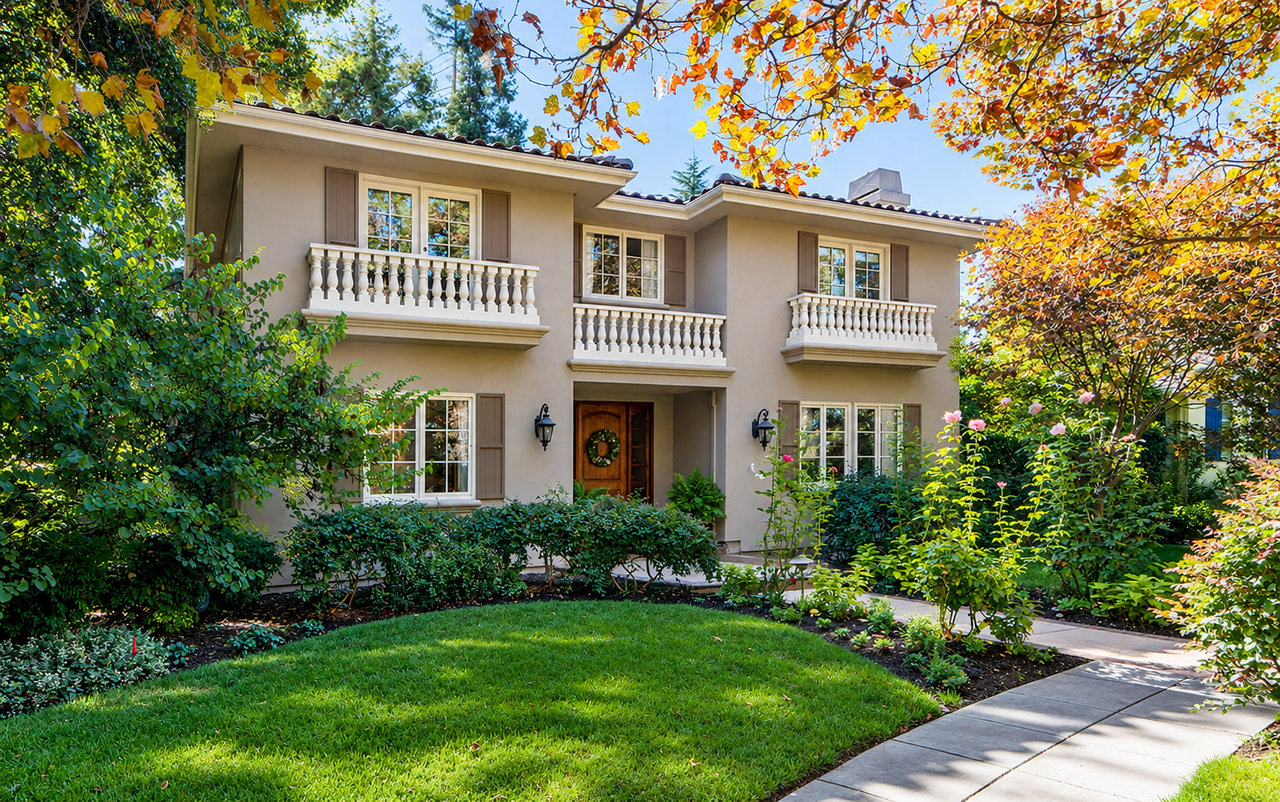
What $4 Million Looks Like Across the Mid-Peninsula
Buying a Home | Neighborhood Guides | Mid-Peninsula October 7, 2026
Buying a Home | Neighborhood Guides | Mid-Peninsula October 7, 2026
Four million dollars is a fixed number. What it buys you on the Mid-Peninsula is not.
Spend $4 million in Palo Alto and you are competing against multiple offers in a city where the median already sits above that figure. Spend the same amount in Woodside and you are standing on an acre or more of forested hillside with no neighbors visible from the back deck. In Menlo Park, $4 million lands you in the heart of a walkable neighborhood with downtown restaurants minutes away. In Portola Valley, it gets you a quarter-acre lot with trail access and a pace of life that feels nothing like the Peninsula below.
The geography is small. The differences are not. Here is what $4 million actually looks like across five Mid-Peninsula communities in 2026, and what each choice is really asking you to prioritize.
Palo Alto is the first place most buyers think of when they come to the Mid-Peninsula with a $4 million budget. The reality check is immediate.
As of early 2026, the median single-family home price in Palo Alto sits at approximately $4.1 million, according to Q1 2026 MLS data. That means $4 million puts a buyer right at the midpoint of the market, not above it. Nearly 40% of single-family purchases in Palo Alto during the first eight months of 2026 were all-cash transactions, and homes in the city are selling for an average of around 4% above asking price, with some neighborhoods running well ahead of that.
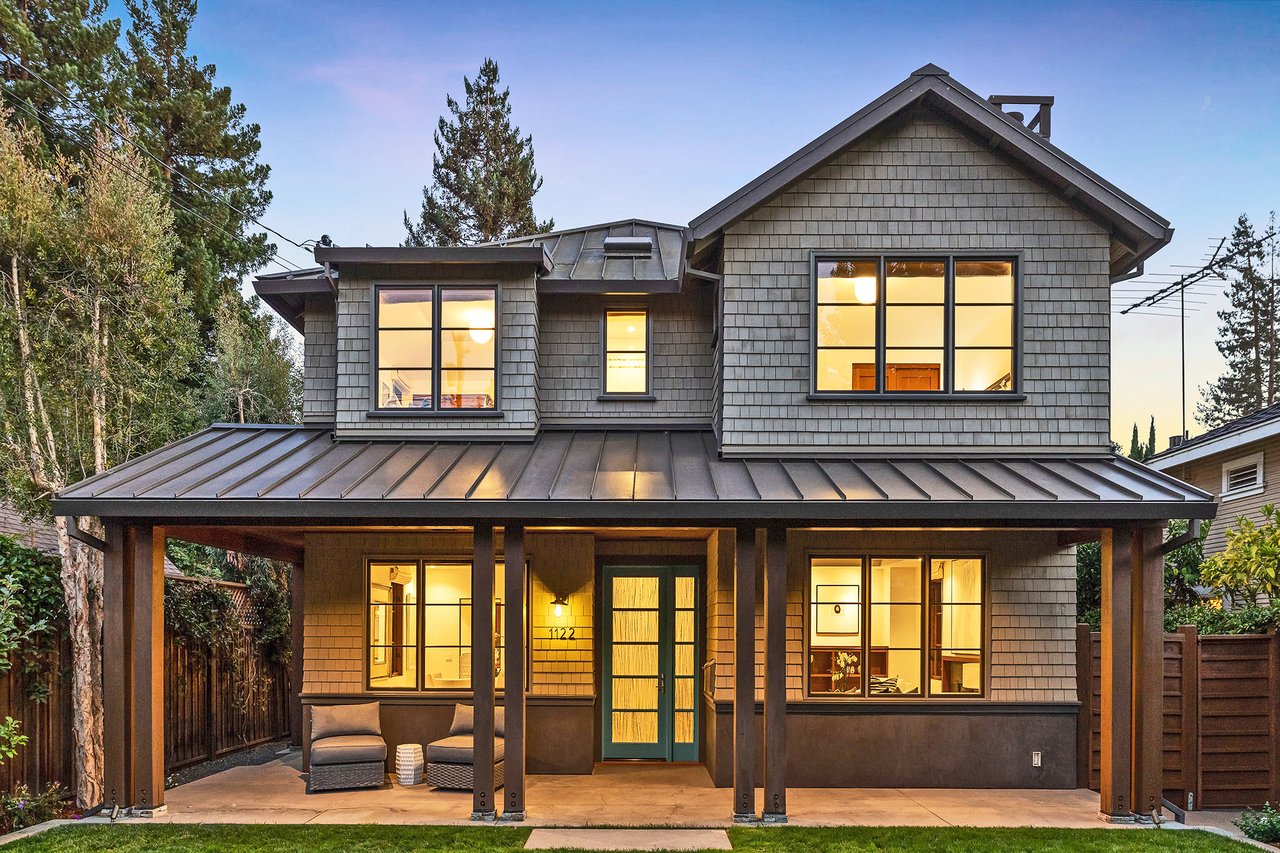
At $4 million in Palo Alto, a buyer is most likely looking at a well-located but modestly sized single-family home, typically three to four bedrooms, somewhere in the 1,800 to 2,400 square foot range, on a standard city lot of 6,000 to 8,000 square feet. Neighborhoods like Barron Park, Midtown, and parts of South Palo Alto are realistic. Old Palo Alto and Crescent Park are not, at least not without accepting a significant trade-off on size or condition. Barron Park specifically saw its median rise approximately 21% during the first eight months of 2026, reaching around $4.3 million.
What a $4 million Palo Alto home delivers that almost nothing else on this list can: school district access. Palo Alto Unified ranked second in the San Francisco Bay Area in Niche's 2026 rankings, and the school premium is built into every transaction at every price point. That is not a coincidence. It is a feature buyers are paying for directly.
What it does not deliver: space, land, or any buffer from the density of a fully built-out urban neighborhood.
Menlo Park's median single-family home price came in at $3.3 million in Q1 2026, which means $4 million gives a buyer meaningful upside relative to the median rather than the Palo Alto experience of landing exactly at it.
The market has also become notably more competitive. In Q1 2026, homes in Menlo Park sold for an average of 7.3% above asking price, surpassing Palo Alto's 4% overbid average and closely matching Los Altos. Three of the 51 single-family homes sold in Menlo Park in Q1 closed for more than $1 million above asking, a rare occurrence that signals meaningful momentum in the upper tier of the market.
At $4 million in Menlo Park, a buyer can realistically target neighborhoods like Allied Arts, The Willows, and parts of Central Menlo: homes in the 2,000 to 2,800 square foot range on standard lots, often with the Mid-Century Ranch or California Ranch architectural character that defines much of the city's residential fabric. Premium neighborhoods like West Menlo and Felton Gables begin their luxury entry points above $5 million, so $4 million in Menlo Park is a strong mid-market position rather than a foothold in the prestige tier.
The practical trade-off works in buyers' favor here. Menlo Park offers genuine walkability to downtown restaurants, cafes, and Caltrain, proximity to Sand Hill Road and Stanford, and a slightly less frantic competitive environment than Palo Alto at the same price point. For buyers where daily lifestyle matters as much as address prestige, Menlo Park at $4 million is often the more interesting buy.
Los Altos is where $4 million starts to feel like a constrained budget rather than a comfortable one.
After a 30% surge in 2025, the Los Altos median single-family home price recalibrated slightly to $5.1 million in Q1 2026. That still leaves $4 million sitting roughly $1.1 million below the current median. In practical terms, that means a buyer at this price point in Los Altos is likely looking at older inventory in need of updating, a smaller lot, or a less central location within the city.
The competitive dynamics compound the challenge. Approximately 70% of Los Altos transactions in Q1 2026 closed above asking price, and one-third of homes sold more than $500,000 above list. Demand for large lots is equally intense, with parcels of 20,000 square feet or more drawing multiple offers, often closing $1 million to $2.5 million over list.
What $4 million in Los Altos still offers, and why buyers keep targeting it at this price point, is school district access. The Mountain View Los Altos High School District was named the top school district in the San Francisco Bay Area in Niche's 2026 rankings. For families willing to accept a smaller or older home to get into that district, $4 million in Los Altos remains a defensible decision with strong long-term appreciation characteristics. It is just a genuinely competitive position in a market where the median buyer is spending considerably more.
In Woodside, $4 million is still a transaction, but it is a different kind of transaction than in any of the three cities above.
Woodside's median sale price reached $5.8 million by March 2026, up 27.1% year over year. At $4 million, a buyer sits below the median but within the market's accessible tier, typically targeting older homes or properties in the hillside neighborhoods rather than the established estate zones closer to town center and Mountain Home Road.
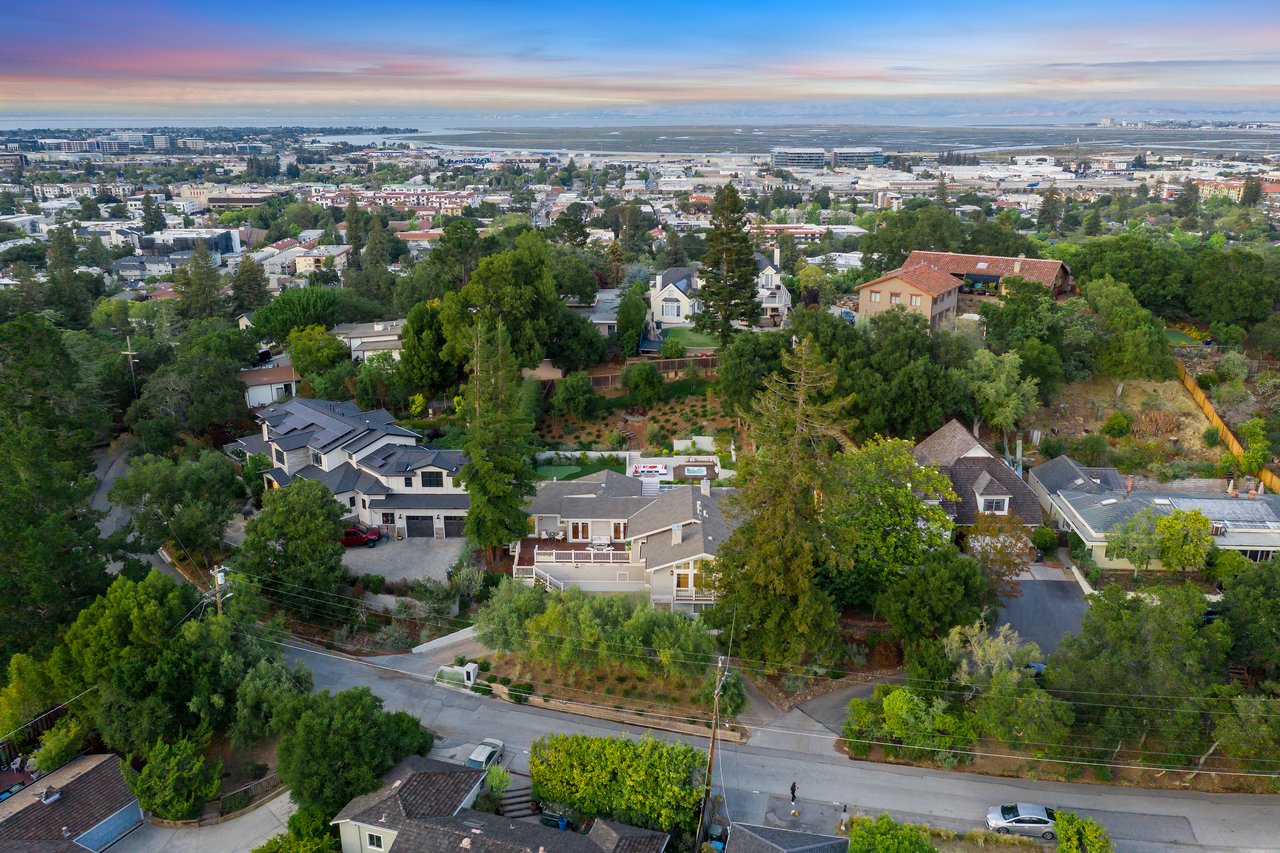
What changes at $4 million in Woodside versus any of the above cities is the land. The Old La Honda Road area, for example, features homes ranging from $4 million to $10 million on multi-acre parcels, with lot sizes far beyond anything available in Palo Alto or Menlo Park at any price. In the more accessible Woodside neighborhoods, a $4 million buyer can realistically expect one to two acres, a property with genuine tree cover and privacy, and the kind of separation from neighbors that is structurally impossible in a standard grid-street city.
The trade-off is equally concrete. Woodside has no commercial center to speak of, no walkable retail, and no transit. Commute practicality depends entirely on car access. And while zoning protections ensure Woodside stays exactly what it is, the same protections mean new construction opportunities are limited and renovation costs on older hillside properties can be substantial. Buyers come to Woodside knowing what they are choosing, and they choose it specifically because it is nothing like the Peninsula below.
Portola Valley sits adjacent to Woodside geographically but operates as a distinct market with its own character, and $4 million lands differently there.
The average Portola Valley home value reached approximately $4.3 million as of April 2026. That makes $4 million a near-median position rather than the below-median experience it produces in Los Altos or Woodside, and it reflects the somewhat wider range of property types available in Portola Valley compared to its neighbor.
At $4 million in Portola Valley, a buyer can find properties in the 2,500 to 3,500 square foot range on lots from a quarter acre to over an acre depending on the specific neighborhood. The Ladera area, which borders Menlo Park on the eastern side of Portola Valley, offers high-value housing in the $4 million to $8 million range on lots of 0.3 to 1 acre and represents a relatively more accessible entry point into this market. Current listings show homes in this range actively available, including a four-bedroom, 2,992-square-foot home on a 0.28-acre lot in Foxwood at just under $4 million.
Portola Valley's pitch to buyers is the same one Woodside makes, open space, trail access, conservation-minded community character, proximity to Stanford and Sand Hill Road, but with somewhat more flexibility on lot size and a slightly lower entry price. Windy Hill Open Space Preserve borders the town directly, offering hundreds of acres of hiking and equestrian trails as a permanent community amenity. For buyers who want the rural lifestyle but not the full Woodside price premium, Portola Valley is consistently the more accessible version of the same idea.
The most useful way to think about $4 million across the Mid-Peninsula is not as a ranking of which city offers the "best" value. Each of these markets is pricing accurately for what it delivers. The question is what a specific buyer actually needs.
If school district access is the primary driver, Palo Alto and Los Altos are where that premium is most concentrated, with Menlo Park offering a credible adjacent option at a slightly more favorable price-to-median ratio.
If walkability, transit access, and proximity to downtown life matter, Menlo Park and parts of central Palo Alto deliver what the hillside communities cannot.
If land, privacy, and a physical break from urban density are the point, Woodside and Portola Valley are the only communities on this list where $4 million can put a buyer on multiple acres with real separation from neighbors.
What none of these cities will do at $4 million is give a buyer everything. That is the honest truth of buying on the Mid-Peninsula at any price point: the trade-offs are real, and understanding them before you start writing offers is what separates buyers who end up happy from buyers who end up compromising on the thing they cared about most.
The Pacific Trust team works across all of these communities and can help you map your specific priorities against what each market actually delivers right now. Whether you are just starting to think through the trade-offs or you are ready to move, we are happy to have a direct conversation about what makes sense for your situation. Reach out to the Pacific Trust team and we are happy to talk through your options.
Stay up to date on the latest real estate trends.
Buying a Home | Neighborhood Guides | Mid-Peninsula
Real Estate 101 | Buying a Home | Midpeninsula
Real Estate 101 | Buying a Home | Selling a Home
Market Update
Real Estate 101 | Buying a Home | Selling a Home
We know that real estate transactions can be complex, but with our expertise, they don’t have to be stressful. Our team is dedicated to handling every aspect of your Mid-Peninsula real estate needs with the utmost care and professionalism. From the initial consultation to the closing, we manage all the details so you can focus on your future. Whatever challenges arise, trust that we’ve got this — your success is our top priority.