5 Historic Homes and Landmarks You Didn't Know Were on the Midpeninsula
Local Living | Midpeninsula | History August 24, 2026
Local Living | Midpeninsula | History August 24, 2026
The Mid-Peninsula is known today for tree-lined streets, highly sought-after neighborhoods, and a real estate market shaped by innovation and proximity to Silicon Valley. But long before today's homes and businesses filled the landscape, the region was defined by ranchos, orchards, railroads, country estates, and communities with stories that stretch back generations.
Some of that history is easy to spot. Some of it is hidden in plain sight.
A historic tree tucked beside a neighborhood. A railroad station that helped transform a rural community. A home connected to the region's earliest development. A preserved property that offers a glimpse into what life looked like before the Mid-Peninsula became one of the world's most recognized technology centers.
These places help explain why communities such as Palo Alto, Menlo Park, Atherton, and the surrounding areas have such a distinctive sense of place.
Here are five historic homes and landmarks worth knowing about the next time you're exploring the Mid-Peninsula.
One of the most remarkable historic landmarks in the region isn't a house or a building. It is a tree.
Standing along San Francisquito Creek, El Palo Alto is a coast redwood believed to be more than 1,000 years old. The landmark has been part of the area's story for centuries and is closely connected to the origins of Palo Alto's name.
According to the City of Palo Alto, Ohlone people revered the tree, and Gaspar de Portolá's expedition camped nearby in 1769. The tree later served as a recognizable landmark for early travelers and surveyors.
Today, El Palo Alto remains a reminder that the history of the Mid-Peninsula extends far beyond the arrival of Stanford University or the rise of Silicon Valley.
The surrounding park is modest in size, but its historical significance is anything but small. It is one of those places that can be easy to pass without realizing that you are looking at a living piece of local history.
For homeowners and visitors alike, it is a fascinating example of how the natural landscape itself can shape the identity of an entire community.
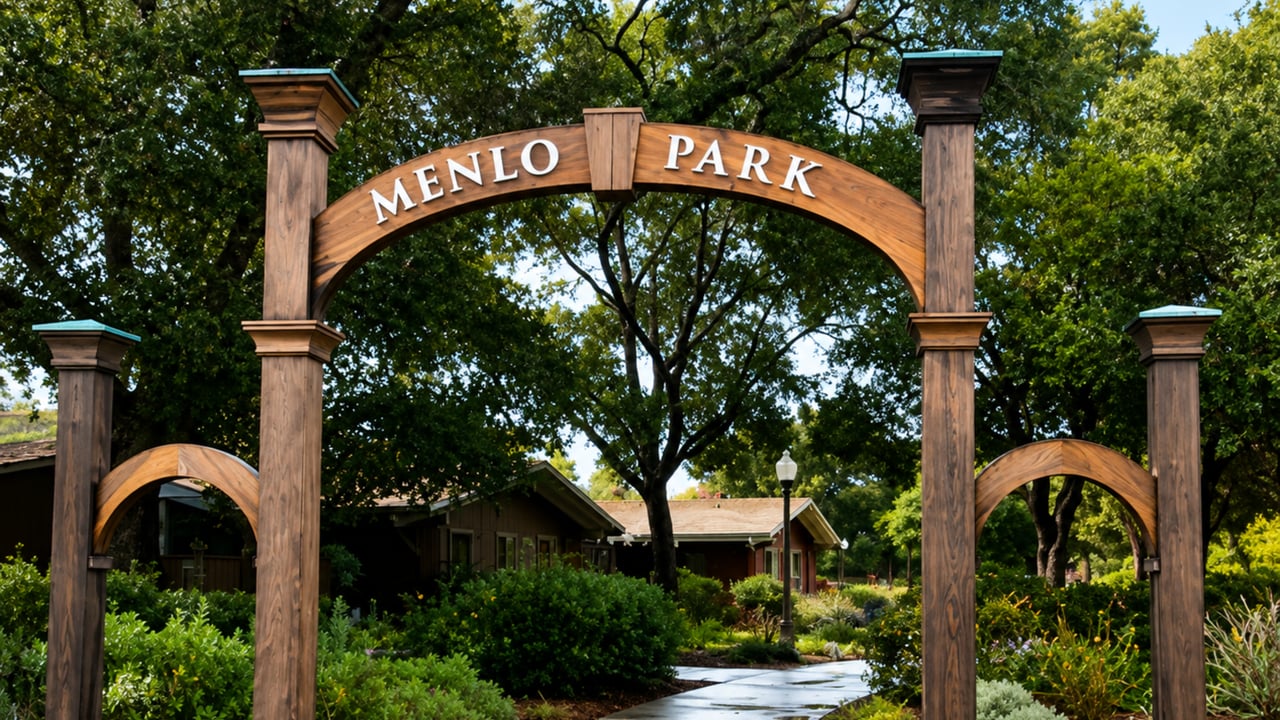
The name "Menlo Park" has a surprisingly specific origin.
In 1854, Irish settlers Dennis J. Oliver and D. C. McGlynn purchased land near what is now El Camino Real and built two homes with a shared entrance. Across the driveway, they erected a large wooden gate bearing the words "MENLO PARK."
The name was inspired by Menlough, their former home in County Galway, Ireland.
When the railroad arrived in the 1860s, the nearby station needed a name. The railroad adopted "Menlo Park," helping establish the name that would eventually become synonymous with the city.
The original gates were destroyed in 1922, but a reproduction was built near the Menlo Park Library in 2019, offering today's residents a physical connection to the story behind the city's name.
The history of Menlo Park is closely tied to transportation and the arrival of the railroad. What began as a rural area accessible by stagecoach became an increasingly desirable destination for San Francisco residents seeking country homes and easier access to the city.
That early connection between transportation, lifestyle, and real estate still feels relevant today. The Mid-Peninsula continues to attract homeowners who value access, community, and the ability to live close to major employment centers while enjoying a more residential setting.
When people think of Palo Alto real estate, they may picture contemporary homes, modern architecture, or the grand properties of today's luxury market.
But some of the city's most interesting properties tell a much older story.
Palo Alto maintains an official Historic Inventory that recognizes properties and districts with architectural and historical significance. The city's preservation program also includes resources listed on the California Register of Historical Resources and the National Register of Historic Places.
This means that throughout Palo Alto, historic character can be found not only in public landmarks but also in residential architecture.
Some neighborhoods contain homes that reflect the city's evolution from a small community into a major center of education, technology, and innovation. Architectural styles, mature landscaping, and original details can offer clues about when and how different parts of the city developed.
For anyone interested in real estate, these properties provide an important perspective. A home is not simply a structure on a parcel of land. In some cases, it is also part of a neighborhood's architectural story.
Palo Alto's historic preservation program recognizes hundreds of individually significant resources, along with four National Register districts. For prospective buyers, that history can add another layer of consideration when evaluating a property, particularly if renovations or additions are being planned.
It is difficult to understand the development of the Mid-Peninsula without understanding the railroad.
In 1863, the railroad reached Menlo Park and Mayfield, the community that would eventually become part of Palo Alto. The connection to San Francisco dramatically changed how people could move through the region.
For wealthy San Francisco residents in particular, the railroad made it easier to establish country homes and estates farther south while maintaining access to the city.
That transportation connection helped shape the early development of communities that are now among the Bay Area's most desirable places to live.
The railroad's influence can still be seen throughout the region. Historic stations, established downtowns, and neighborhoods that developed around transportation corridors all reflect the infrastructure decisions made more than a century ago.
The connection between transportation and real estate remains just as relevant today. Homes near major transit options and regional employment centers continue to attract attention from buyers who want a balance between convenience and community.
In many ways, the Mid-Peninsula's evolution from rural landscape to residential destination began with the ability to connect these communities to San Francisco and the wider Bay Area.
Long before today's streets and subdivisions, much of the Mid-Peninsula was shaped by large ranchos and land grants.
The history of Palo Alto, for example, includes Rancho Rinconada del Arroyo de San Francisquito and Rancho La Purisima Concepcion, associated with the Soto/Greer family and Juana Briones. These early landholdings covered areas that later became part of the modern community.
That history is easy to overlook when driving through today's neighborhoods.
A street lined with mature trees and carefully maintained homes may look entirely contemporary, but the land itself may have been part of a much larger agricultural or ranching landscape generations ago.
This layered history is one of the things that makes the Mid-Peninsula particularly interesting from a real estate perspective. The region's communities have evolved dramatically, but traces of earlier eras remain embedded in the landscape.
The transition from ranchos and agricultural land to residential neighborhoods helped create the foundation for the communities we recognize today.
History may not be the first thing that comes to mind when discussing the Mid-Peninsula real estate market, but it is part of what gives these communities their character.
Palo Alto's historic neighborhoods, Menlo Park's railroad roots, the grand estates and mature landscapes of communities such as Atherton and Woodside, and the area's early ranching history all contribute to a sense of place that cannot easily be replicated.
For buyers, that character can be part of the appeal.
A historic home may offer architectural details that are difficult to find in newer construction. A mature neighborhood may have a streetscape shaped over decades rather than years. A property with a connection to local history may offer a sense of continuity that extends beyond the walls of the home.
At the same time, historic properties can come with unique considerations. Buyers may need to understand preservation requirements, renovation restrictions, or the implications of a property's historic designation before making changes.
The City of Palo Alto, for example, maintains different levels of historic recognition and provides resources for homeowners researching a property's history or considering modifications. Understanding those details is an important part of evaluating a historic property.
The Mid-Peninsula is often defined by what it is today: a global center of technology, entrepreneurship, education, and innovation.
But its identity was built long before the modern tech economy.
The communities we know today were shaped by Native American history, Spanish and Mexican land grants, agriculture, railroads, country estates, and generations of families who helped establish the towns and neighborhoods that followed.
That history is still visible if you know where to look.
The next time you're driving through Palo Alto, walking around Menlo Park, or exploring the communities along the Peninsula, take a closer look. Some of the most interesting stories in the region are hiding in plain sight.
Every property has a story, whether it is a century-old home with original architectural details or a newer residence built on land that has been part of the community's history for generations.
At Pacific Trust Real Estate, we believe understanding the character and history of a neighborhood is an important part of understanding its real estate landscape. Our team combines local market knowledge with a deep appreciation for the communities we serve across the Mid-Peninsula.
Whether you're exploring historic properties, considering a move, or simply curious about how your neighborhood has evolved, we're always happy to help you learn more about the place you call home.
Stay up to date on the latest real estate trends.
Local Living | Midpeninsula | History

Market Update
Homeownership | Home Maintenance | Mid-peninsula
Real Estate 101 | Buying a Home | Midpeninsula

Real Estate 101 | Portola Valley
Real Estate 101 | San Carlos
We know that real estate transactions can be complex, but with our expertise, they don’t have to be stressful. Our team is dedicated to handling every aspect of your Mid-Peninsula real estate needs with the utmost care and professionalism. From the initial consultation to the closing, we manage all the details so you can focus on your future. Whatever challenges arise, trust that we’ve got this — your success is our top priority.